

Adaptive Response to Changing Environments
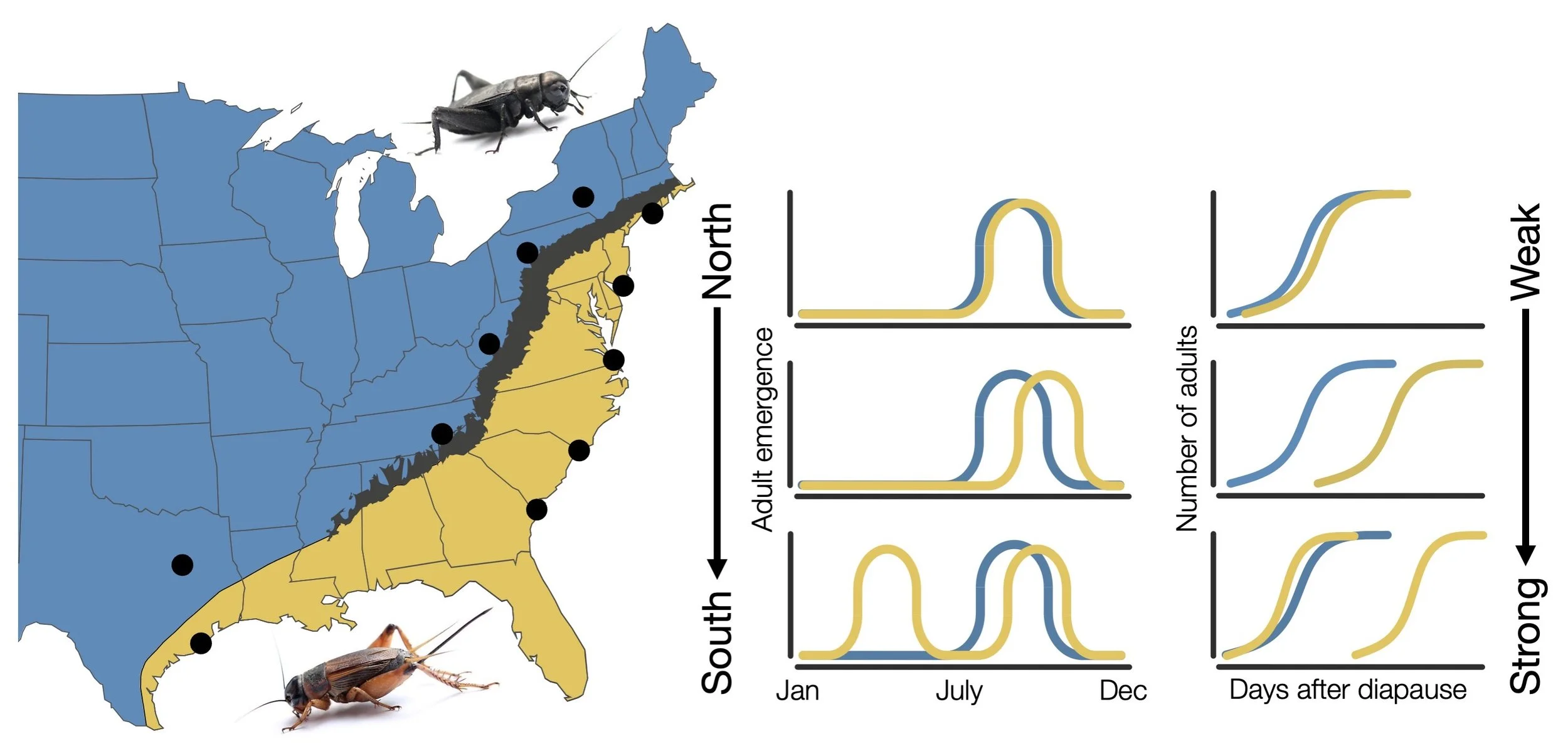
Understanding the processes that have shaped contemporary patterns of biodiversity, as well as the processes that continue to shape them, has long been a central goal of biology. This is especially true as contemporary global climate change continues to cause species to shift and adapt their ranges, life history traits, behaviors, and species interactions. Using the field cricket hybrid zone we aim to understand how species are adapting to novel and changing environments and how these adaptations lead to the formation, persistence, and/or collapse of species boundaries.
How do climate change induced phenological mismatches affect temporal isolation and hybridization?
While global climate change presents a threat to biodiversity, these fluctuations in climate can also offer new opportunities to study outstanding questions in evolution and speciation, especially over rapid timescales. How species are responding to the contrasting selection pressures imposed by climate change and phenological mismatches via phenotypic plasticity or rapid evolutionary adaptation remains an open question. We are currently using an integrative genotype-phenotype-environment approach across the latitudinal range of the field cricket hybrid zone to determine how variability of seasonal life history traits (e.g., diapause and development) in response to a changing climate affect the persistence, formation, and/or collapse of temporal species boundaries.

Header photo: Sierra Vista, Arizona 2019
How do barrier phenotypes and their underlying genomic architecture persist or change over temporal scales?
Many studies have focused on the repeatability of evolution at the level of single traits/genes or in easily manipulated lab organisms. While it is much harder to understand the repeatability of selection on whole genomes in natural populations, hybrid zones are a unique opportunity to understand how divergent genomes recombine in hybrids. An avenue of our research tests the hypothesis that selection on recombinant genomes is repeatable over variable temporal scales across the field cricket hybrid zone. We are (1) using patterns of introgression in the hybrid zone to test the strength and repeatability of selection across the genome, (2) associating phenotype and genotype to test whether hybridization alters the strength of reproductive barriers, and (3) comparing key genomic regions and phenotypes across areas of the hybrid zone that differ in ages of contact.